Security Toolkit
Nine security tools in Python and Go with zero third-party dependencies — from subdomain discovery and port scanning to JWT auditing and CVE triage, wired together by a one-command pipeline. Every tool ships as a standalone binary and is exercised by unit + integration tests on every push.


Authorized use only. These tools are meant for education, CTFs and testing systems you own or have explicit permission to assess.
Live demo
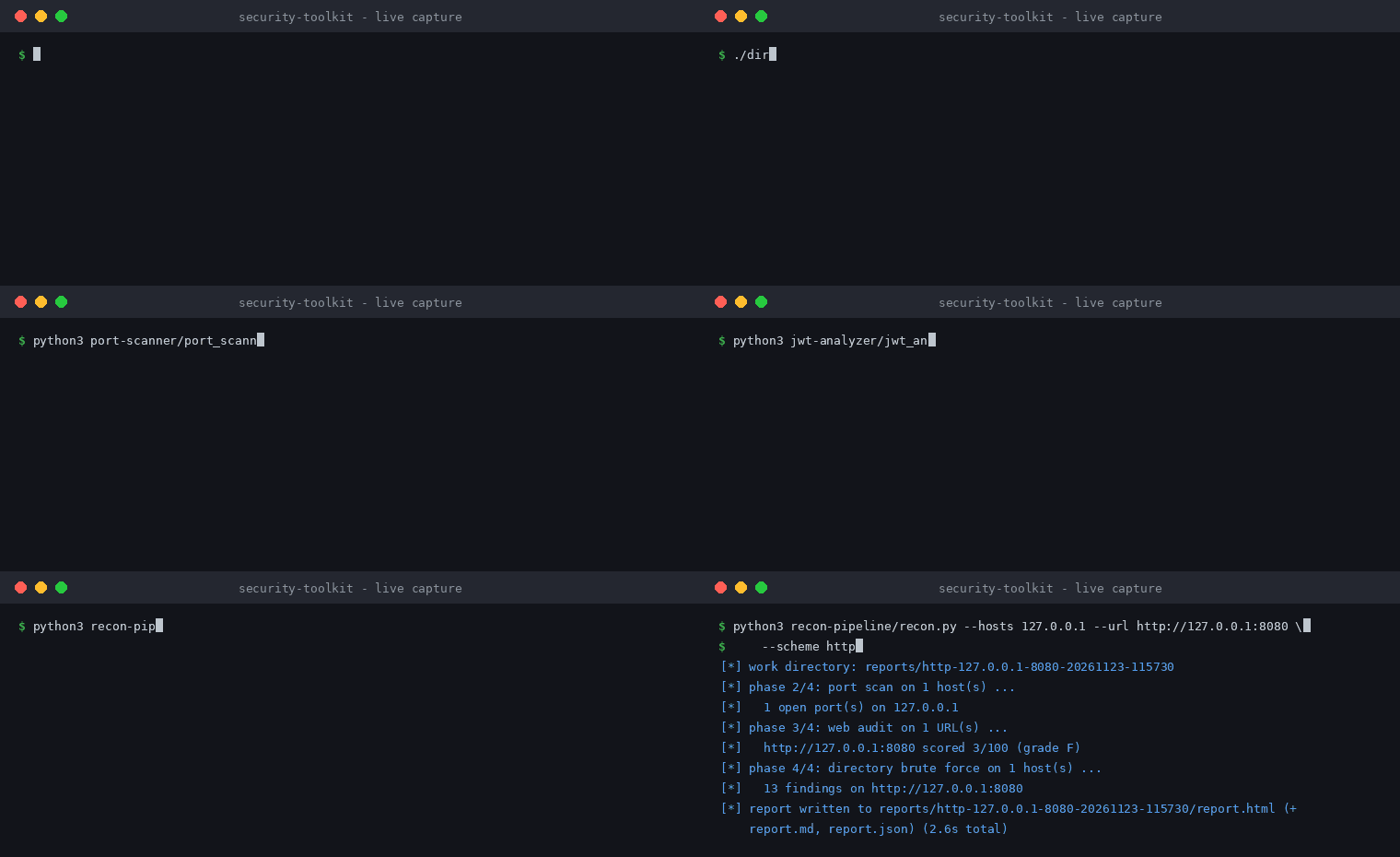
Live terminal capture — five tools run for real against a local demo webserver (hash cracking, directory brute force, a port scan, a JWT audit and the consolidated pipeline). Every line is the tools’ verbatim stdout, recorded in one take:
An older walkthrough GIF built from the captured runs in the examples directory is here.

The tools
| Tool | Language | What it does | Tutorial |
|---|---|---|---|
| subdomain-enum | Python 3 | Subdomain discovery via crt.sh and threaded DNS brute force | guide |
| port-scanner | Python 3 | TCP connect scan of a curated top-100 list with banner grabbing | guide |
| takeover-check | Python 3 | Subdomain takeover detection with CNAME + body fingerprints for 17 hosting services | guide |
| web-audit | Python 3 | TLS certificate + security-header audit that scores targets 0-100 with a letter grade | guide |
| jwt-analyzer | Python 3 | Offline JWT audit: decode, verify HMAC signatures, crack weak secrets, flag alg: none |
guide |
| cve-lookup | Python 3 | Turn banners, keywords or CVE ids into CVSS-ranked CVE lists via the official NVD API | guide |
| dirbrute | Go | Threaded directory and file brute-forcer with wildcard filtering | guide |
| hashcrack | Python 3 | MD5 / SHA-1 / SHA-256 / SHA-512 cracking with wordlists and rule chains | guide |
| recon-pipeline | Python 3 | Chains four tools into one HTML/JSON/Markdown report | guide |
Downloads
Release tags build standalone binaries automatically — no interpreter, no runtime, no packages — and attach them with sha256 checksums to the matching GitHub release. Grab them on the releases page, or browse the full release-by-release history in CHANGELOG.md.
Quick start
$ python3 port-scanner/port_scanner.py scanme.nmap.org --top 100
$ python3 jwt-analyzer/jwt_analyzer.py "$TOKEN" --wordlist secrets.txt
$ python3 cve-lookup/cve_lookup.py --from-scan scan.json --severity critical,high
$ python3 recon-pipeline/recon.py --domain example.com   # full report run
Every pipeline run writes report.html — a self-contained, dark-themed
report page that renders offline — plus report.md, report.json and the
raw tool logs. See a captured one
here.
CI/CD and quality gates
Two GitHub Actions workflows keep the toolkit green and ship the binaries:
CI
(byte-compile + unit + integration tests on Python 3.11/3.12, gofmt/go vet/
go build on Linux, macOS and Windows) and
Release binaries
(tag-driven builds, each artifact smoke-tested before publish). The full
pipeline documentation lives in
actions.md.
Project map
- Source code — nine single-file tools
- Step-by-step tutorials — every flag explained live
- Captured examples — real output from real runs
- CI/CD pipeline docs
- CONTRIBUTING.md · SECURITY.md · MIT License